

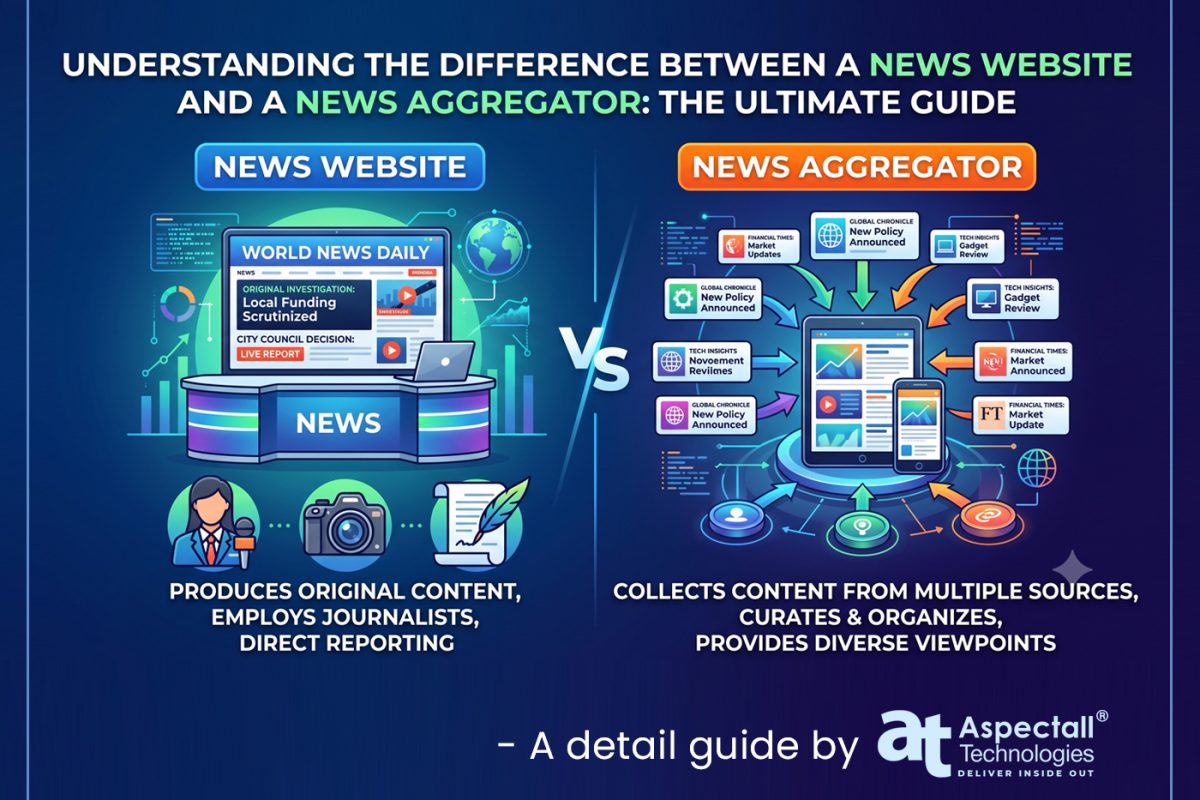
“Understanding the Difference Between a News Website and a News Aggregator: The Ultimate Guide” – A detail guide by Aspectall Technologies®, a complete 360° Web Development company in Kolkata, India
Think back to the quiet magic of a morning routine just a few decades ago. Mornings were defined by the familiar, comforting thud of a physical newspaper landing on your front porch. You’d brew a fresh cup of coffee, sit at the kitchen table, and feel the thin paper between your fingers as you turned the pages to uncover the latest local, national, and international stories. The source of that news was deeply personal, singular, and straightforward—it was the specific newspaper you trusted and invited into your home.
Today, the digital revolution has completely rewritten how we connect with the world. We no longer wait for tomorrow’s paper to understand yesterday’s events; the world breaks in real-time, vibrating in our pockets on smartphones, tablets, and laptops. But with this incredible, lightning-fast connection comes a heavy, sometimes exhausting burden: a massive flood of information. Every single minute, thousands of passionate opinion pieces, urgent breaking updates, and deep investigative reports are poured into the internet.
To help us survive this overwhelming daily data flood, the digital world evolved two distinct lifelines: the traditional digital news platform and the modern curation app.
Whether you are a casual reader feeling buried by your daily feed, a visionary entrepreneur dreaming of launching a digital media empire, or simply a curious citizen of the web, understanding the new aggregator and news website ecosystem is absolutely essential. At first glance, they might look like twins. Both tempt you with catchy headlines, draw you in with stunning high-resolution images, and offer a window into politics, sports, entertainment, and technology.
But beneath that sleek surface, their beating hearts, underlying architectures, and core philosophies couldn’t be more different.
In this comprehensive, step-by-step guide, we are going to explore the news website vs new aggregator debate with deep empathy for both the creators and the readers. We will uncover where their stories are born, the human effort behind them, real-world examples, and the heavy moral weight they carry in our modern information age.
By the end of this journey, you will know exactly which platform speaks to your reading soul—or better yet, which one you should strategically build for your next big digital venture.
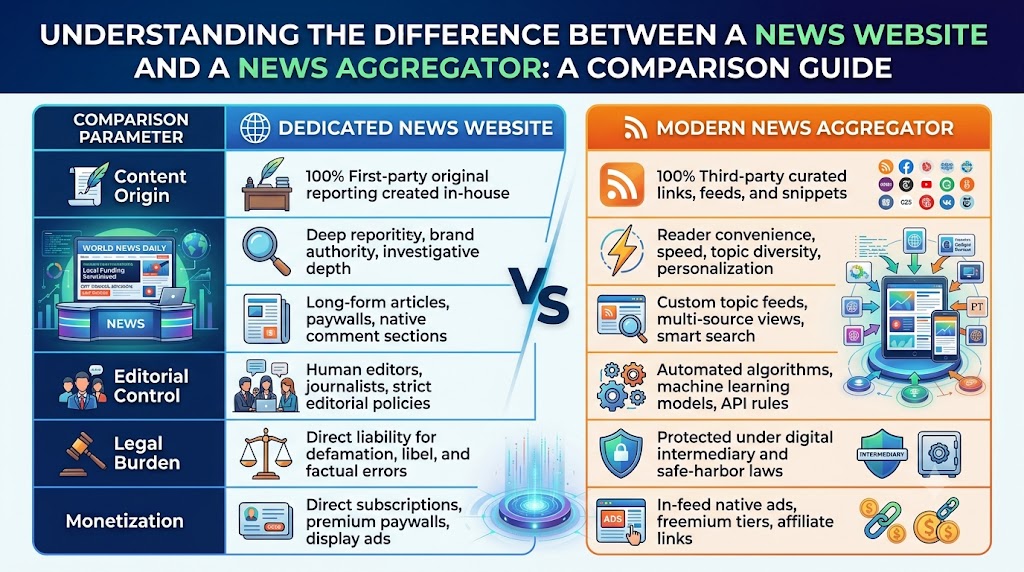
Difference Between a News Website and a News Aggregator: Head-to-head comparison
Step 1: The Soul of the News Website (Original Creation)
To truly appreciate the digital landscape, we must first honor the foundation of all journalism: the news website.
A news website is the digital evolution of the traditional printing press. It is a dedicated online sanctuary owned, funded, and fiercely protected by a media organization, an independent publisher, or a brave collective of journalists. Its primary heartbeat is original creation. These platforms employ professional journalists, boots-on-the-ground field reporters, exhausted but dedicated editors, and brilliant photographers to hunt down the truth, conduct exclusive interviews, unravel complex webs of facts, and write stories you can’t find anywhere else.
The Human Cost of the Truth
When a major event shakes your city, a news website sends a real human being into the chaos. That reporter gathers direct quotes from shaken witnesses, verifies critical details with local authorities, captures copyrighted photographs, and pours their energy into a unique piece of journalism. That piece is then meticulously scrubbed by a senior editor for clarity, unbiased tone, and legal safety. This process demands time, immense financial investment, and, above all, passionate human effort.
When you type the URL of a trusted news website into your browser, you are walking into their home. Everything you see is shaped by their unique worldview, their style guide, and their dedication to the facts. You trust them because they have spent years earning that trust, one factual story at a time.
Step 2: The Genius of the News Aggregator (Intelligent Curation)
If a news website is a high-end, exclusive restaurant cooking original, complex recipes from scratch, a news aggregator is the ultimate, sprawling global food court, bringing the very best dishes from thousands of chefs under one perfectly organized roof.
A news aggregator (often called a feed reader or a news curator) is a sleek digital platform—either a responsive website or a beautifully designed mobile application—that collects, organizes, and displays stories from across the web in one centralized, stress-free location.
The Silent Power of the Algorithm
Aggregators do not sleep. They use brilliant, sophisticated technologies like RSS feeds, complex APIs, and advanced web scraping algorithms (often built on powerful Python or Node.js backends) to continuously monitor thousands of websites worldwide, 24/7.
When a traditional publisher breaks a story, the aggregator’s software feels the pulse instantly. In a fraction of a second, it pulls the headline, the featured thumbnail, and a brief, enticing snippet of text, displaying it beautifully on its own platform. If a reader feels the spark of curiosity and clicks, the aggregator acts as a bridge, redirecting them to the original creator to read the full story.
Modern aggregators are deeply personal. They use powerful Artificial Intelligence and Machine Learning to silently learn what matters to you. If you constantly read about space exploration or advanced AI, the algorithm takes loving note. Soon, it curates a daily newspaper where you are the sole, most important audience member, placing exactly what you care about right at the top of your feed.
Step 3: Head-to-Head: The Core Differences
To make the distinction crystal clear, let’s compare these two platforms across the categories that matter most.
1. The Origin of the Content
- News Website: 100% First-Party. They are the creators. Every word is born in-house.
- News Aggregator: 100% Third-Party Curation. An aggregator creates zero original reporting. It acts as a highly sophisticated digital librarian, perfectly organizing the shelves so you can find the truth in seconds.
2. The Primary Objective
- News Website: Deep Authority. They exist to inform, investigate, and build unshakeable brand loyalty.
- News Aggregator: Convenience and Variety. In our chronically busy world, aggregators save us precious time. More importantly, they burst harmful “filter bubbles.” By showing you how five different publishers cover the exact same controversial event, they offer a broader, healthier, and more holistic understanding of the truth.
3. Features You Will Love
- News Aggregator Features:
- Highly Customizable Feeds: Follow granular passions (like “Kolkata Local Business News” or “AI Breakthroughs”) and mute the noise you hate.
- Algorithmic Magic: A “For You” section that feels like it reads your mind based on past clicks.
- Source Filtering: The power to permanently block publishers you find biased or untrustworthy.
- Cross-Platform Harmony: Start reading on your phone during your commute, and pick up exactly where you left off on your desktop at the office.
4. The Heavy Weight of Responsibility
- News Website (High Moral & Legal Risk): They are legally and ethically responsible for every single syllable. A false accusation can result in massive defamation lawsuits. They must protect whistleblowers and fund rigorous fact-checking departments to guard their fragile reputations.
- News Aggregator (The “Safe Harbor”): Because they only curate, aggregators operate under internet “safe harbor” laws (like Section 230). If a pulled link contains a lie, the original publisher is legally liable, not the aggregator. However, the best aggregators still bear a massive moral responsibility. They must fiercely combat sensationalism and clickbait, actively banning toxic sources from their automated feeds to protect the public mind.
Step 4: Building the Dream: Tech Stacks & Entrepreneurship
Are you a visionary business owner or an ambitious startup founder ready to carve out your own highly lucrative space in digital media? The choice between building a news website and an aggregator will dictate your entire business plan, your budget, and the brilliant minds you need to hire.
Empowering the Creator (The News Website)
If your heart beats for original publishing, you need a robust, impregnable Content Management System (CMS). Your platform must be lightning-fast to hold reader attention, highly secure against malicious attacks, and flawlessly optimized for Search Engines so your scoops rank #1.
If you want to build a scalable, powerful sanctuary for original journalism, partnering with a top-tier News website development company in Kolkata is a highly strategic move. A specialized digital engineering team can craft a custom WordPress or headless CMS tailored to your writers, integrate seamless subscription paywalls (like Stripe), and guarantee your servers won’t crash when your viral story breaks the internet.
Engineering the Curator (The News Aggregator)
Building an aggregator requires an entirely different, incredibly complex technological symphony. You don’t need writers; you need brilliant software engineers, data scientists, and UI/UX artists. You need custom recommendation algorithms, robust API pipelines, and intuitive mobile interfaces built on React Native or Flutter.
This requires bleeding-edge technical mastery. If you are chasing this ambitious dream, investing in new aggregator web appliaction development in Kolkata connects you with premier IT solution experts who deeply understand the media and entertainment sectors. They can construct the heavy backend infrastructure required to scrape, parse, and deliver content in milliseconds without violating stringent copyright laws.
Firms like Aspectall Technologies stand at the absolute forefront of this digital media transformation. They consistently empower businesses to launch scalable, breathtakingly fast, and immensely profitable platforms. Having a dedicated IT partner ensures that while you focus purely on your grand business strategy and marketing vision, the headache-inducing technical complexities are handled flawlessly.
Step 5: A Beautiful Symbiosis (Why They Need Each Other)
It is easy to look at the screen and see bitter competitors fighting tooth and nail for your limited attention. But the reality is a beautiful, deeply symbiotic relationship. They rely on each other to survive.
Aggregators are recognized today as one of the most powerful, consistent lifelines of free traffic for original news websites. When a giant like Google News features a brilliant piece from a small, independent publisher, it instantly sends hundreds of thousands of new, curious readers to that site in mere hours. These are readers who would never have found that story otherwise. The news website can then monetize this massive influx of traffic or convert these one-time visitors into loyal, paying subscribers.
In short: News websites generously provide the essential raw material (the truth), and aggregators provide the massive, unparalleled distribution network (the global audience).
Step 6: SEO Strategies: Winning the Digital Game
From a strict digital marketing perspective, these platforms play entirely different games to win Google’s heart. Understanding this is the secret to immense growth.
- For News Websites: The SEO strategy is aggressive, fast-paced, and built on authority. The goal is the coveted “Top Stories” carousel. This means perfectly targeted keywords, flawless meta descriptions, lightning-fast Core Web Vitals (often utilizing AMP), and precise Schema markup (like the NewsArticle tag) to tell search engine bots exactly what the story is. They fight to be the #1 authoritative source the second an event happens.
- For News Aggregators: The enemy is “duplicate content.” To rank high, modern aggregators must strategically inject their own unique “SEO value.” They do this by building dynamic, beautifully designed category hubs (e.g., “The History of AI Development”). They utilize brilliant internal linking and rely on User-Generated Content (UGC) like comments and upvotes to make the page unique in Google’s eyes. They don’t fight for a single breaking story; they optimize for massive, highly-trafficked category terms like “Best Technology News Today” or “Live Cryptocurrency Updates.”
The Future of Information
Navigating the shifting tides of digital information doesn’t have to be overwhelming. The fundamental difference between a new aggregator and news website boils down to one beautiful concept: original creation versus intelligent curation.
A news website is the brave, beating heart of journalism. It is born from the intense dedication of writers uncovering the truth to comprehensively inform the public. A news aggregator is the brilliant, tireless digital curator—an organizational masterpiece driven by cutting-edge AI that saves us time and offers a panoramic view of the world on a single screen.
Both are absolutely vital. News websites are the engines of truth; aggregators are the high-speed highways that deliver that truth to our hands.
Whether you are a reader trying to find peace in your morning news routine, or a passionate entrepreneur ready to build the next great global platform with visionary tech partners like Aspectall Technologies, understanding this delicate ecosystem is your first step to mastering the digital age. Embrace the platform that fits your life, or strategically use both to stay truly informed, balanced, and deeply connected to the world around you.
Frequently Asked Questions (FAQs)
To make this journey as clear as possible, let’s address the most burning questions about this complex ecosystem.
Is it actually legal to create a news aggregator without getting sued?
Yes, it is entirely legal, provided you strictly respect the rules of “fair use.” You cannot legally copy and paste an entire 1,000-word article—that breaks copyright laws and the hearts of writers. You are, however, allowed to pull the headline, a small thumbnail, and a short, one-to-two-sentence snippet. Crucially, you must provide a highly visible, clickable link back to the original creator’s platform.
Can a digital platform be BOTH a news website and a news aggregator?
Absolutely! This hybrid model is incredibly popular and highly effective. Companies like Yahoo! News employ brilliant in-house journalists for exclusive stories while simultaneously featuring API-pulled feeds from partners like Reuters or CNN. It gives the reader the absolute best of both worlds.
Do aggregators steal advertising money from hard-working journalists?
This is an emotional, ongoing debate. Traditionalists argue that keeping readers on an aggregator app steals ad revenue. Conversely, many publishers celebrate aggregators for driving unprecedented, massive waves of new traffic to their sites, ultimately increasing their revenue. To protect creators, regions like the EU and Australia have passed historic laws forcing tech giants to pay licensing fees for displaying snippets.
Which is cheaper to launch today?
An aggregator is generally much cheaper to run month-to-month because you are spared the heavy payroll of dozens of writers and editors; the algorithms do the heavy lifting automatically. However, the initial upfront capital required to engineer a flawless, AI-driven aggregator is substantial. Consulting experts in robust web application architecture is vital so you don’t waste your budget on bad code.
How do I know if I am reading an aggregator or a true news website?
Look at the byline. If every article says “Written by John Doe for Website A,” you are in the home of a news website. If one article says “Source: The New York Times” and the next says “Source: BBC,” and clicking them takes you away to new URLs, you are enjoying the convenience of an aggregator.
Are social media platforms like X (Twitter) or LinkedIn considered aggregators?
Technically, they are massive social aggregators. Millions use them purely to aggregate news by following specific journalists and outlets. However, they rely on human sharing rather than automated web scraping.
Why do some premium publishers block aggregators?
Elite legacy papers with strict, highly expensive paywalls (like The Wall Street Journal) fiercely protect their brand image and content distribution. They use special backend code (like robots.txt rules) to intentionally block aggregator bots from touching their hard-earned journalism.
What is the technical foundation needed to build a high-quality news website?
You need a rock-solid CMS (like a highly customized WordPress or a modern headless architecture for multi-channel speed). You need premium cloud hosting, seamless CDN integration for global image loading, and a stunning mobile-first frontend. Working with a dedicated digital engineering team ensures your platform scales securely and beautifully.
Disclaimer: This blog and all its contents are protected by copyright, owned entirely by Aspectall Technologies®. We strictly prohibit the use, duplication, or transmission of any text, screenshots, or featured imagery for commercial or non-commercial purposes without obtaining direct, written permission from an authorized representative of our company. Legal action will be taken against any unauthorized use.
Read Also:
- How to make WordPress website with SEO Friendly URL structure
- How Celebrity PR Agencies Manage Social Media Presence: Digital PR & Social Media Management Services in Kolkata
- How a Top Performance Marketing Agency in Kolkata Can Scale Your Business
- The Advantages of Using a Content Management System (CMS)
- Why Choose a Kolkata-based Web Design Company for Your Business
- Tips for Improving Website Loading Speeds
- Importance of Responsive website for online businesses: in-depth analysis